
The Dreaded CC
Few workplace behaviours tell you more about the health of an organisation than the humble CC field.
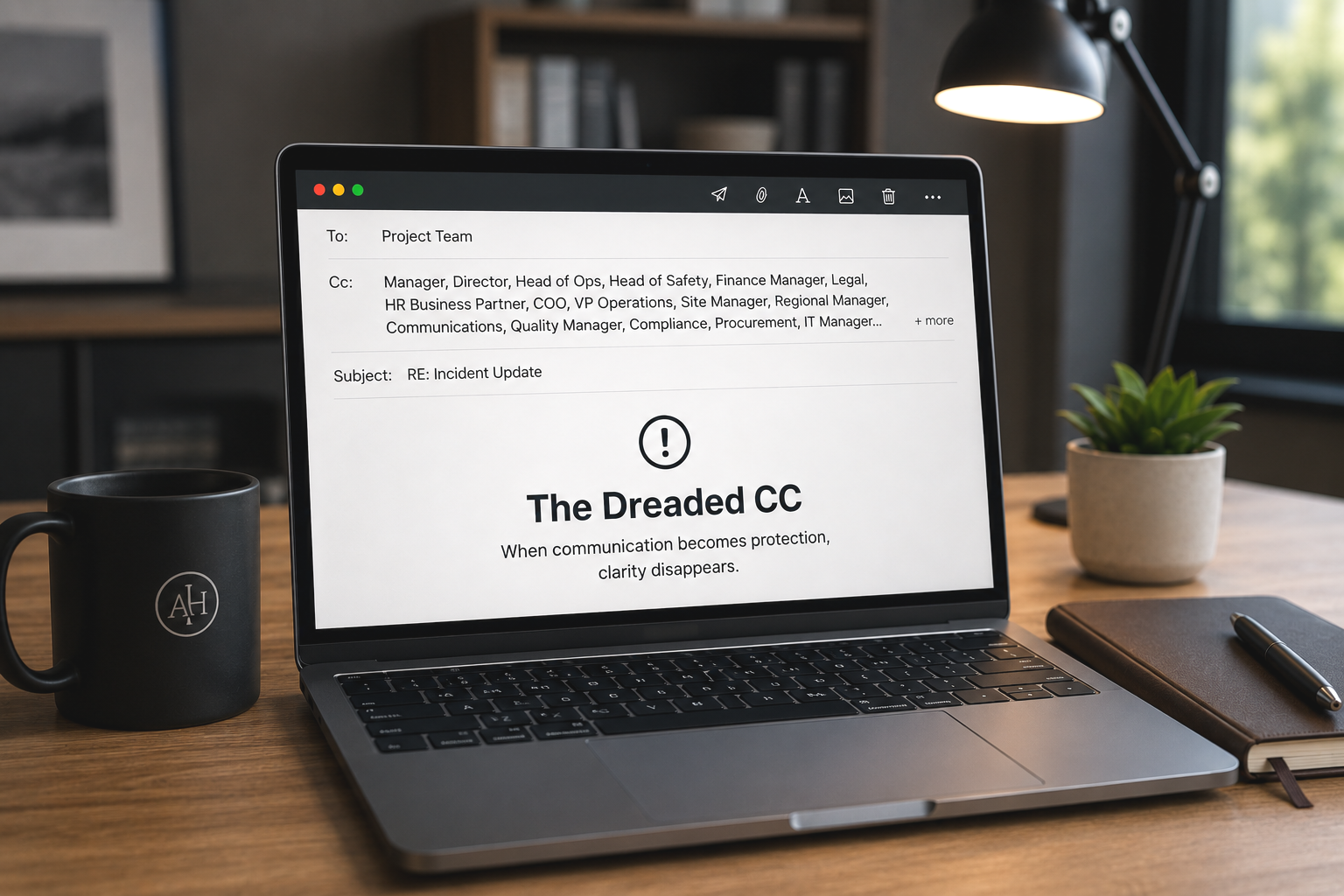
Most people view excessive CC'ing as an inbox problem. An irritation and another symptom of modern working life where email, Teams messages and meeting invites compete endlessly for our already overburdened attention. But in my experience, excessive CC'ing is rarely a communication problem. It is usually a trust problem.
There is a brilliant quote often attributed to Ashton Kutcher that describes email as "everyone else's to-do list for you." There is more truth in that observation than many realise. Every email is effectively asking someone to do something, decide something, approve something, oversee something or simply be aware of something.
The challenge for leaders is that it's easy to spend an entire day reacting to work that other people have assigned to them, whilst making little progress on the things only they can do. It's equally easy to become so overwhelmed by inbound traffic that the intention of keeping people informed actually achieves the opposite. Information increases, but clarity decreases.
CC'ing takes this one step further. At its best, the CC field exists to keep relevant people informed. At its worst, it becomes a form of organisational body armour.
I remember sitting in a serious meeting discussing a safety incident. I was presenting at the time and noticed an email notification appear in the corner of my screen. Nothing unusual there, but as I talked they just kept coming. The email had six or seven people copied in.
Around eight minutes later I finished speaking and glanced back at my inbox. The same email chain was still going. The number of people copied in had grown to eleven, including the COO. Various people had felt the need to add their view, copy somebody else in or offer another opinion. One or two had launched the written equivalent of Exocet missiles. In the eight minutes I had been presenting, more than 120 emails had been generated.
At that point I sent a simple response, "No further emails on this thread please." In the aftermath a number of meetings with the stakeholders involved ensued to pick the bones out of what had occurred.
The issue wasn't the email itself. The issue was that nobody seemed entirely comfortable with where ownership sat, who could make the decision or whether they would be supported if they did. Consequently, defensive barriers went up and a “blue on blue” blame game commenced instead.
People CC managers because they do not trust an issue will be addressed. They CC senior leaders because they want visibility. They CC half the organisation because nobody is entirely sure who owns the decision, or because they want to make a point. Sometimes they CC people simply because they want evidence that they raised the issue in the first place.
The purpose shifts from communication to protection. That is where things become interesting. Every unnecessary CC tells a story about the culture that created it. A lack of trust. Unclear ownership. Fear of challenge. A need for visibility or attention. An absence of accountability. None of those are email problems, they are leadership, culture and accountability problems.
The more organisations drift towards blame, politics and low trust, the more email becomes a defensive mechanism rather than a communication tool. People stop using email to exchange information and start using it to build evidence trails.
The irony is that organisations often respond by introducing more reporting, more meetings and more controls, which creates even more email and even less clarity.
Healthy organisations tend to feel very different. People know who owns decisions, because roles and responsibilities are understood. Leaders trust people to act and support them when mistakes inevitably happen, because accountability is clear.
As a result, communication becomes simpler. There is less copying, less escalation and less noise because there is less need for protection.
One of the simplest ways to assess the health of an organisation is to look at its inboxes. When trust is high, communication is usually direct. When trust is low, everyone gets copied in.
The dreaded CC may seem like a minor workplace frustration, but it often reveals something far more important about the culture that created it.