
Continuous Short-Termism
The hidden cost of borrowing from the future.
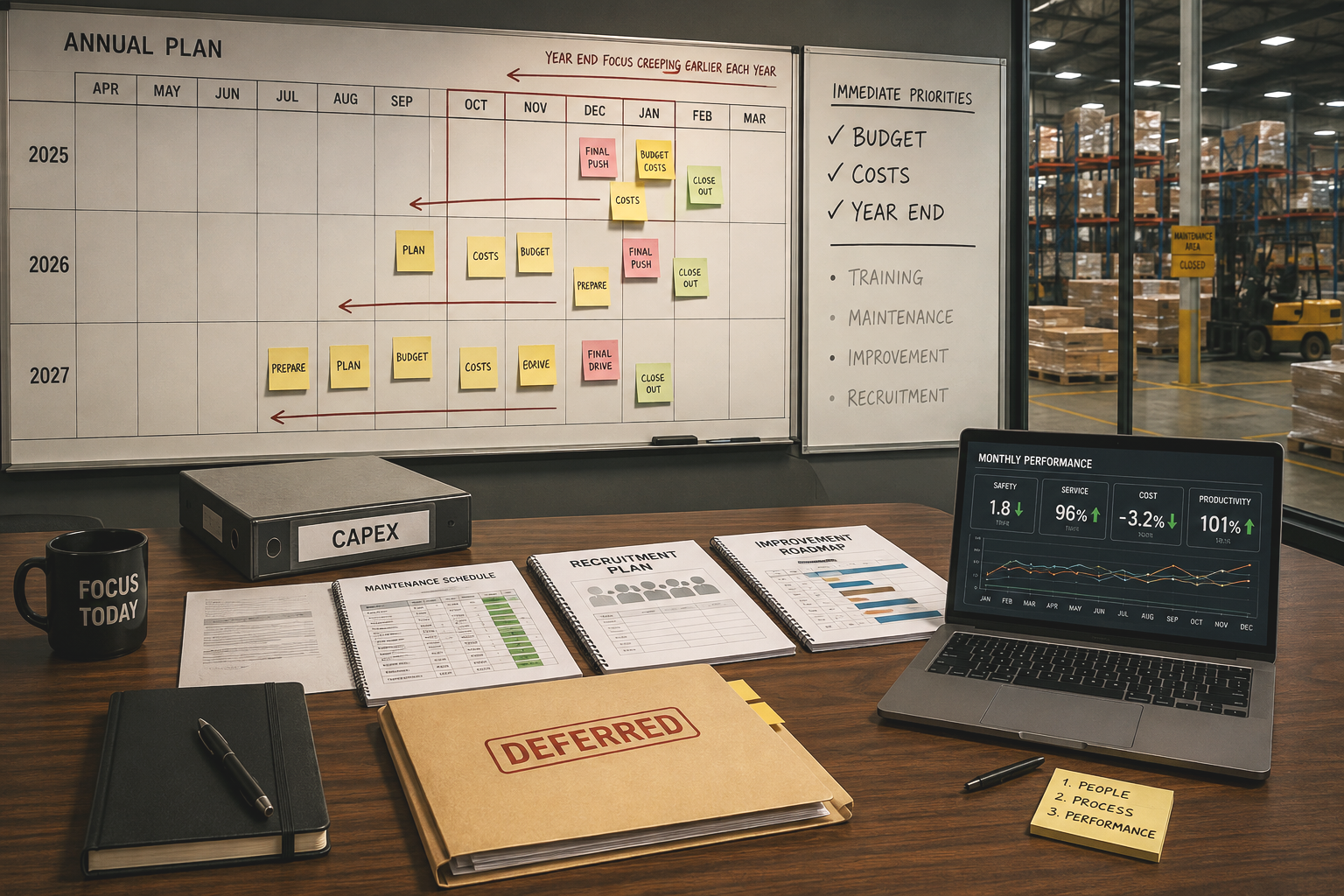
Every organisation occasionally has to borrow from the future. Unexpected events happen. Markets change. Customers expect more. Budgets are trimmed. Priority focuses shift. Sometimes difficult trade-offs are unavoidable. The problem isn't borrowing from the future. The problem is never paying it back.
It starts innocently enough. Preventative maintenance becomes next month's job. Recruitment is delayed. Training is rolled until next quarter. System improvement projects are put on hold. CAPEX Investment decisions are deferred until "things are more stable."
Each decision feels reasonable. Each decision solves today's immediate problem. Each decision creates a bigger one for tomorrow. The problem is when tomorrow never comes.
Individually, they're difficult to spot. Collectively and over time, they become the new unofficial operating model. With the bill continuing to grow invisibly in the background, one decision at a time.
At the same time, the organisation becomes a little harder to run. Equipment becomes less reliable. Assets become more tired. Capability develops at a slower pace. Vacancies remain vacant for longer. Customers become incrementally less satisfied. Colleagues feel a little more jaded. Leaders spend more time firefighting. None of it feels significant, until a point in time when it all does.
One of the most obvious examples appears at the end of the financial year. Almost every organisation experiences a period of heightened focus on budgets, costs and financial performance. That's completely understandable. The problem is when that period continues to expand year on year. What was once the final fortnight becomes the final month. Then six weeks. Then two months. Eventually, the fourth quarter. Each year the business starts protecting this year's numbers a little earlier than the last, all in pursuit of outperforming the previous financial year.
Few people stop to ask what that expansion costs, but the focus subtly shifts from creating future value or genuine growth to safeguarding current performance. This tends to be the moment when borrowing from the future stops being a temporary decision and starts becoming an operating philosophy.
The greatest threat isn't the size of the debt, although that can be significant. It's what happens next. Eventually the growing bill becomes part of the organisational narrative. Rising costs, declining performance, increasing workloads, attrition and constant operational pressure are used as reasons not to invest in the very things that would reverse the trend.
Yesterday's short-term decision making added to today's headwinds. Those headwinds then justify tomorrow's short-term decisions. The organisation becomes trapped by the very mindset that created the problem. Hence, the cycle repeats and what began as a temporary response increasingly becomes the culture.
The irony is that most leaders involved never intended this outcome. Each decision made sense in isolation. Each solved a genuine problem at that moment in time. But organisations don't experience decisions in isolation. They inherit the cumulative effect of thousands of them.
Organisations must recognise when they've borrowed from the future and make a conscious effort to repay the debt. They need to invest before the bill becomes unsustainable. They need to resist allowing temporary compromises to become permanent habits.
Continuous short termism isn't ultimately a financial problem, but can cause them. It's a leadership problem. The organisations that escape it don't simply make better decisions. They understand the value in looking beyond the short-term.